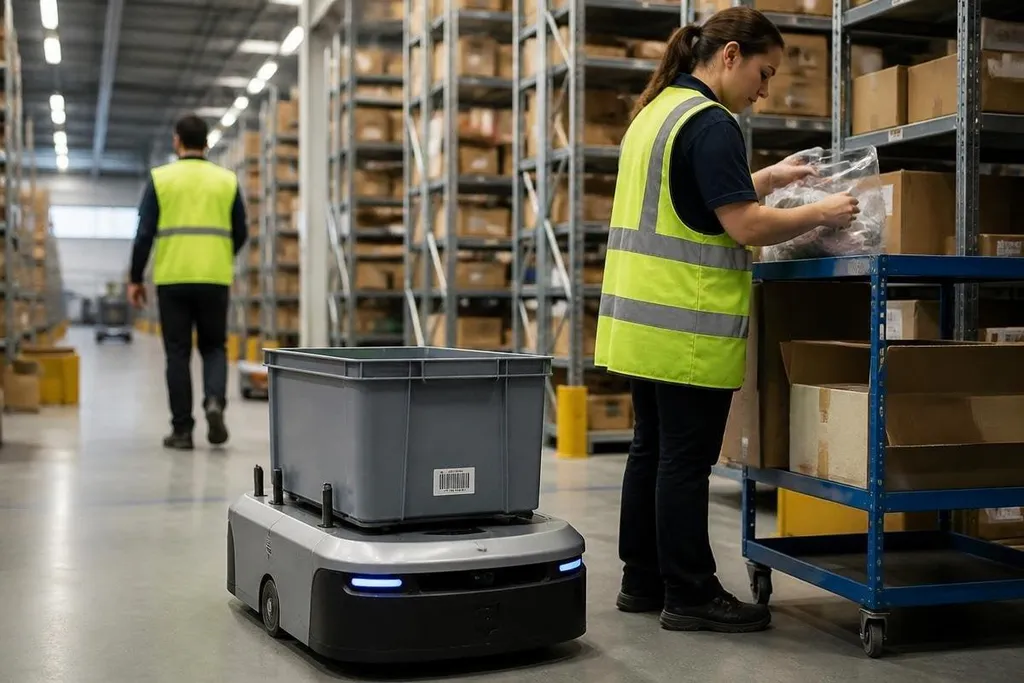
A logistics robot can move a tote across a warehouse in a clean video. The harder task is repeating that move beside people, changing stock, narrow aisles, damaged boxes, and a charging plan that fits the shift.
This is what the future of logistics robots will be judged on: steady work in ordinary sites, not a single successful run.
- Reliable movement between fixed work areas
- Safe handoffs beside warehouse staff
- Clear costs for setup, service, and downtime
The work will spread beyond transport
Autonomous mobile robots, or AMRs, already fit a clear task: moving shelves, bins, or totes between set points. An AMR uses sensors such as LiDAR, which measures distance with laser pulses, to build a map and avoid obstacles.
That basic job will lead to harder ones. One machine may need to collect a carton from a rack, pass it to a conveyor, read a barcode, and return without blocking a person carrying a load. Each extra step adds another place where software, sensors, and the warehouse layout can fail.
The useful change will come when one robot can handle a complete work loop. A machine that only carries a bin still leaves the picking, checking, and handoff work to people.
A system that links those steps can cut walking time, but only if its gripper can handle the real mix of packaging found at that site.
People will remain part of the system
Logistics sites change through the day. A forklift may stop in a marked lane, a pallet may sit outside its assigned area, or a worker may need to cross the robot’s route. Future machines will need to read those changes and choose a safe response.
Safety depends on more than a stop button. Speed limits, warning lights, guarded zones, floor markings, and clear rules for human handoffs all shape the result. Good obstacle detection can still create delays if workers don't know where the robot will go next.
Remote support will matter too. When a robot cannot identify a package or reaches a blocked path, a person may need to inspect the scene and send it a new instruction. That person could support several machines, but the number depends on how often each one needs help.
Those handoffs belong in the business case. A robot that needs frequent help may shift work rather than remove it. Use logistics robotics coverage from Robot24.com to compare that labor with the machine’s output before the next section counts the full cost.
The hard part will be the business case
The purchase price is only one line in the budget. The site may also need new charging points, floor changes, network coverage, software links to warehouse systems, spare parts, training, and paid service time.
The right measure is not how many tasks the robot can perform once. It is how many useful tasks it completes during working hours, how often a person must step in, and what happens when the system stops.
This makes deployment data more useful than a polished video. A buyer should ask for the number of robots in the site, the hours they run, the rate of human intervention, and the work each machine completes per shift. If the maker cannot share those figures, the financial case is still open.
I'd skip any purchase based only on a fast demonstration. A slower system with clear service rules and steady handoffs may fit a warehouse better than a machine that needs help every few minutes.
What still needs proof
Several parts of the market remain open. General-purpose robot hands must deal with soft bags, crushed cartons, loose wrapping, and objects placed at odd angles. Vision systems must read labels under glare and low light. Fleet software must keep many machines from waiting at the same doorway.
The industry also needs better proof of long-term service. Motors wear, wheels collect dirt, batteries lose capacity, and sensors need cleaning. A short pilot may show useful work, but daily operation over months may need a different service plan.
Those limits don't cancel the value of logistics automation. They set the work that makers and buyers must measure before signing a contract.
A buying checklist for the next deployment
Use these checks before you compare robot models:
- Ask for shift data from a site doing the same work, not a lab demo.
- Count every person needed for loading, recovery, remote support, and service.
- Check the robot's path beside forklifts, people, fire exits, and charging points.
- Price software links, spare parts, battery replacement, training, and downtime.
- Set a clear test period with targets for completed tasks and human interventions.
The next useful proof will be simple: a logistics robot running through a normal shift, handling the exceptions, and showing its service record. Until makers publish that evidence, the future belongs to the systems that can keep working after the camera stops.